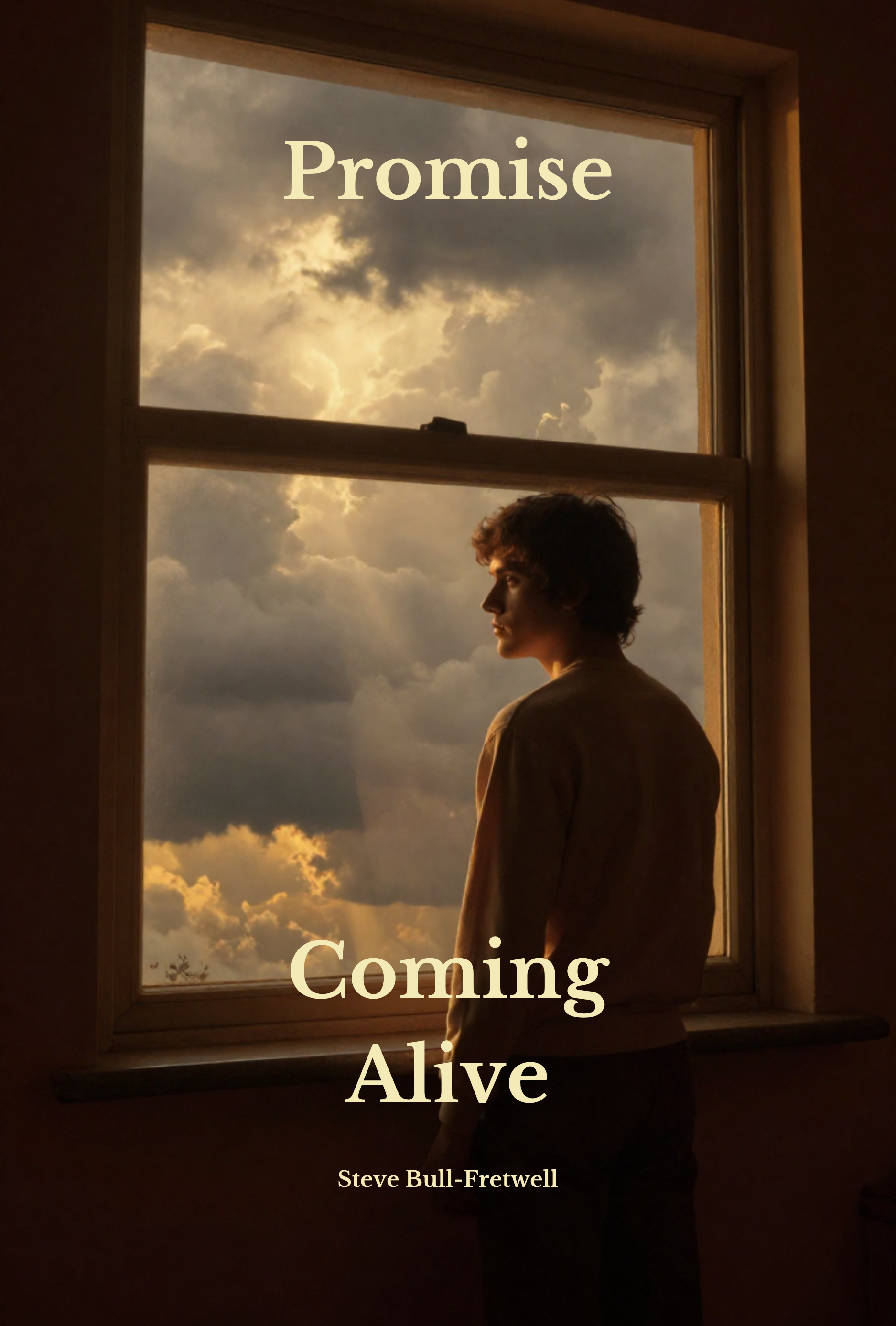
The ceiling was white. Plain white. No texture. No cracks. No water stains like the one in Mary’s living room that looked like a bird if you stared at it long enough. Just white.
Peter lay on the narrow bed in his dorm room and stared at that ceiling, his hands folded on his chest, his breathing slow and measured.
In. Out. In. Out.
The room was small. Maybe ten feet by twelve. Two beds—one on each side. Two desks. Two dressers. Two closets barely wide enough to fit a few boxes of belongings. A window that looked out over the quad.
Peter’s side of the room was organized and complete. His clothes were folded in the dresser. His few books were stacked on the desk. His toothbrush and comb sat on the small shelf in the bathroom he shared with his neighbor—a boy he hadn’t met yet, whose door had been closed when Peter arrived.
The bed was made with the sheets Aunt Lynn had given him. Crisp. Clean. Tucked in at the corners the way his mother had taught him.
Everything was in its place. Everything was organized. Everything was done.
The other side of the room was empty. Untouched. The bed was bare, just a mattress with no sheets. The desk was clean. The dresser drawers were open and empty. The closet door hung ajar, revealing nothing inside.
His roommate hadn’t arrived yet. Peter didn’t know when he would.
And now Peter lay on his bed and stared at the white ceiling and felt the weight of it all crash down on him.
What am I going to do?
The question echoed in his mind, relentless and unanswerable. What am I going to do now?
He was fourteen and a half years old. And he was three hundred miles from home. Three hundred miles from Cathy and Michelle. Three hundred miles from Aunt Lynn and Uncle Jerry’s farm, where his sisters were probably sitting at the kitchen table right now, confused and scared, wondering why their brother had left them. Who’s going to look after them the way I do?
Where Carrie was probably in the barn, feeding the chickens or helping with chores, maybe thinking about him. Where Nathan might be visiting.
Peter’s chest tightened. Aunt Lynn would take care of them. He knew that. She was kind. She was loving. She would feed them and clothe them and make sure they were safe. But would she know that Michelle was afraid of the dark and needed a nightlight?
Would she know that Cathy had nightmares about Mary and needed someone to sit with her until she fell back asleep?
Would she know that they both needed to be told—every single day—that they were good, that they were loved, that they weren’t dirty or lazy or wrong?
I should be there. I should be with them. I promised Mom I would take care of them. Peter’s hands clenched on his chest.
He’d made that promise while his mother was dying. She taught him how to cook, do the laundry, and keep the household running. Peter thought it was for only two weeks. He didn’t realize she meant a lifetime.
And now he was here. Three hundred miles away. In a strange place. With people he didn’t know. Doing things he’d never done before.
I broke my promise. The thought was a knife in his chest.
I left them. I abandoned them. Just like Luke abandoned me.
And Carrie—his rock, his anchor, the one person who loved him without conditions or expectations—was far away on that farm, probably wondering if he was okay.
Peter closed his eyes and felt the tears burn behind his eyelids. But he didn’t let them fall. He couldn’t. Because if he started crying now, he wasn’t sure he’d be able to stop.
So he lay there. Breathing. Staring at the white ceiling. And trying to figure out what the hell he was supposed to do now.
After a while—ten minutes, maybe twenty—Peter sat up.
He couldn’t just lie here. He couldn’t just stare at the ceiling and spiral into guilt and fear and the crushing weight of everything he’d lost.
He had to do something. He had to move. He had to figure out what came next. Peter stood up and walked to the window.
Outside, the campus stretched out before him. Buildings made of red brick and white stone. Trees lined the walkways.
A grounds crew was working near the main building—two men trimming hedges with electric shears, their movements methodical and practiced. Another worker was edging the walkways with a string trimmer, the high-pitched whine carrying across the quad. A truck was parked near the chapel, and someone was unloading bags of mulch, preparing the flower beds.
The campus was being readied. Prepared. Made perfect for the students who would arrive in the coming days.
But right now, it was quiet. Almost empty. Just workers and a handful of early arrivals like Peter.
This is my life now. This is where I live. This is where I’m going to go to school. This is where I’m going to work.
The thought was strange. Almost impossible to believe.
Peter turned away from the window and looked at the small room. His side of the room. His space.
For the first time in his life, he had a space that was entirely his own. No hide-a-bed in the living room. No Christopher sleeping three feet away. No Mary walking through at any moment.
This was his. And he didn’t know what to do with that. He didn’t know how to be alone. He didn’t know how to make choices without considering everyone else first. He didn’t know how to just… be.
Figure it out, he told himself. You have to figure it out.
Peter grabbed his jacket from the hook by the door and stepped out into the hallway.
The campus was bigger than it had looked from his window.
Peter walked slowly, his hands in his pockets, his eyes taking in everything.
The buildings were old but well-maintained. The pathways were clean. The trees were tall and thick, their branches reaching toward the sky like they’d been here forever.
Near the gymnasium, someone was pressure-washing the sidewalk, the spray creating a fine mist that caught the afternoon light.
A few students passed him—early arrivals like himself—but most were alone, walking with purpose, heading somewhere specific.
Peter was used to that. Being alone. Being overlooked. At least, that’s what he’d always told himself. But it did make him feel small. Like he was walking through a world that didn’t quite have space for him.
Stop it, he told himself. You’re here. You’re supposed to be here. Just—figure out where you’re going.
He knew he’d be working in the cafeteria. Marybeth Greenhurst—the cafeteria manager—had sent him a letter a few days ago explaining the job, the hours, the expectations. She’d told him to come find her when he arrived on campus so they could go over everything.
Peter had read that letter a dozen times. He’d memorized every word. And now, walking across the unfamiliar campus, he decided that’s where he’d go.
The cafeteria. At least there, he’d have something to do. At least there, he’d have a purpose.
And maybe—maybe if he could cook, if he could do the one thing his mother taught him—he wouldn’t feel so far away from everyone.
From home.
The cafeteria was on the far side of campus, past the academic buildings, the chapel, and the gymnasium. It was a large, low building with wide windows and double doors that opened into a dining hall filled with long tables and chairs.
Peter stepped inside.
The dining hall was empty. Quiet. The tables were clean, the chairs pushed in, the floor polished to a shine. It smelled like industrial cleaner and faint traces of food—bread, maybe, or soup.
Peter walked through the dining hall toward the back, where a set of swinging doors led to the kitchen.
He hesitated for a moment.
What if she’s not here? What if I’m interrupting something? What if— Stop it.
Peter pushed through the doors.
The kitchen was massive. Stainless steel counters stretched along the walls. Industrial ovens and stovetops lined one side. A walk-in refrigerator hummed in the corner. Shelves stacked with pots, pans, and utensils filled the space above the counters.
And in the middle of it all stood a woman.
She was small—maybe five-foot-two—and stout, with broad shoulders and strong arms. Her hair was pulled back in a bun, and she wore a white apron over a simple blouse and slacks. She was scrubbing down one of the counters, her movements efficient and practiced.
When Peter stepped through the doors, she looked up.
“Can I help you?” she asked. Her voice was warm. Not sharp. Not impatient. Just warm.
Peter cleared his throat. “I’m looking for Mrs. Greenhurst.”
The woman smiled. “You found her.” She set down the rag and walked toward him, wiping her hands on her apron.
“You must be Peter,” she said.
Peter nodded. “Yes, ma’am.”
“None of that ‘ma’am’ business,” she said, waving her hand. “Call me Marybeth. Mrs. Greenhurst makes me feel like I’m a hundred years old.”
Peter blinked. “Marybeth,” he repeated.
“That’s better.” She smiled again, and Peter felt something in his chest loosen slightly.
She wasn’t like Mary. She wasn’t cold or sharp or calculating. She was just… kind.
“Come on,” Marybeth said, gesturing for him to follow. “Let me show you around.”
For the next thirty minutes, Marybeth walked Peter through the kitchen. She showed him where everything was stored: the dry goods in the pantry, the fresh produce in the walk-in cooler, the frozen items in the freezer.
She explained how the equipment worked: the industrial ovens that could cook fifty trays at once, the stovetops with burners the size of dinner plates, the mixers that could handle twenty pounds of dough.
She showed him the prep stations, the dishwashing area, and the serving line.
And the entire time, she talked. Not in a way that felt overwhelming or condescending. Just explaining and teaching. Making sure Peter understood.
“You’ll mostly be working breakfast and lunch,” Marybeth said as they stood by the prep station. “Dinner’s handled by the full-time staff. But breakfast and lunch—that’s where we need the student cooks.”
Peter nodded, his mind working to absorb everything.
“Do you have any experience cooking?” Marybeth asked.
Peter hesitated. “My mother taught me,” he said quietly.
Marybeth’s expression softened. “Did she?”
“Yes, ma’am—” Peter caught himself. “I mean, yes. Marybeth.”
She smiled. “What did she teach you?”
Peter thought about it. “Everything,” he said. “How to cook by feel. How to taste as you go. How to make a meal out of whatever you have.”
Marybeth studied him for a moment, her eyes thoughtful. “She sounds like she was a good teacher.”
“She was,” Peter said.
His throat tightened, but he pushed the emotion down.
Not here. Not now.
Marybeth seemed to sense something in his silence. She didn’t push. Instead, she gestured toward the stove.
“How about you show me what you can do?”
Peter looked up, surprised, glancing around the enormous kitchen. “Now?”
“Why not?” Marybeth said. “I’ve got time. And I’d like to see what you’re capable of.”
She walked to the refrigerator and opened it, gesturing inside. “Make me something,” she said. “Anything you want. Use whatever you need.”
Peter stared at her. “Anything?”
“Anything,” Marybeth said. “Surprise me.”
Peter stood in front of the open refrigerator. He took a deep breath, scanning the industrial shelves, taking stock of what he had to work with. Then something inside him quietly settled.
This… This, he knew how to do.
His eyes cataloged the ingredients. Chicken breasts. Fresh lemons. Butter. Garlic. Shallots. Green beans. Rice.
His mother’s voice echoed in his mind.
Lemon-pepper chicken, mijo. It’s simple, but if you do it right, it’s perfect.
Peter’s hands moved without thinking. He pulled out the chicken, the lemons, the garlic, the shallots, the green beans. He grabbed a pot for the rice and a pan for the chicken. He turned on the stove.
And then he cooked.
The kitchen filled with the smell of garlic and butter. Peter minced the garlic and shallots with quick, precise cuts, the way his mother had taught him. He melted butter in the pan and added the garlic, letting it sizzle until it was fragrant but not burned.
He seasoned the chicken with salt, pepper, and lemon zest, then laid the breasts in the pan. They sizzled immediately, the sound sharp and satisfying.
While the chicken cooked, Peter started the rice. He added chicken broth instead of water, a trick his mother had taught him to make it richer. He squeezed fresh lemon juice over the rice and stirred it in.
Then he turned to the green beans. He trimmed the ends and blanched them quickly in boiling water, just long enough to soften them but not long enough to lose their color. Then he tossed them in a pan with more garlic and shallots, a little butter, and a squeeze of lemon.
The chicken was golden now, the skin crispy and perfect. Peter flipped it and let it finish cooking, then plated everything carefully.
Chicken on one side. Rice on the other. Green beans arranged neatly beside them. He drizzled a little of the pan sauce over the chicken and stepped back.
It looked… right. It smelled like home.
And for a moment—just a moment—Peter didn’t feel three hundred miles away from his sisters. He felt close to them. Connected. Through his mother’s hands working in his own.
Peter turned to find Marybeth standing a few feet away, watching him. She hadn’t said a word the entire time. She’d just—watched.
“Here,” Peter said quietly, handing her the plate.
Marybeth took it and walked to the counter. She picked up a fork and cut into the chicken.
Peter held his breath.
She took a bite. Chewed slowly. Swallowed. Then she looked up at him, her eyes wide.
“Well,” she said softly. “Don’t we have quite the chef on our hands?”
Peter felt his face flush. “It’s just… it’s what my mom taught me.”
“Your mom taught you well,” Marybeth said. She took another bite, then another. “This is restaurant-quality, Peter. You know that, right?”
Peter didn’t know what to say.
Marybeth set down her fork and looked at him. “I was going to offer you a position washing dishes or prepping vegetables,” she said. “But I think we can do better than that.”
Peter’s heart started to pound. “What do you mean?”
“I want you to be one of the student cooks,” Marybeth said. “Not just helping. Actually cooking. Planning meals. Running the line.”
Peter stared at her. “I… I don’t know if I can—”
“You just did,” Marybeth said. “And you did it beautifully.” She smiled. “What shift do you want to work?” she asked. “Breakfast or lunch?”
Peter blinked. “I… I don’t know. I don’t even know what my class schedule is yet.”
“That’s fine,” Marybeth said. “We’ll figure it out. Bring me your schedule when you get it, and we’ll work around it.”
She paused. “Can you come back tomorrow?” she asked. “I’d like you to help me with breakfast. Just a small group—maybe twenty-five students. It’ll be a trial run. See how you do with a crowd.”
Peter’s eyes went wide.
“Twenty-five people?”
“Is that a problem?”
“I’ve never cooked for that many people before.”
Marybeth laughed—a warm, genuine sound. “You’ll be fine,” she said. “And Peter? During the school year, you’ll be cooking for about seven hundred and fifty people. Students and faculty combined.”
Peter felt the blood drain from his face. “Seven hundred and fifty?”
“Give or take,” Marybeth said. “But don’t worry. You won’t be doing it alone. There’s a whole team. And we prep everything in advance. It’s organized. Efficient. You’ll get the hang of it.”
She reached out and squeezed his shoulder. “You’ve got talent, Peter,” she said. “Real talent. I can work with that.”
He just nodded.
“Tomorrow morning,” Marybeth said. “5:30 AM. We’ll start with scrambled eggs, bacon, toast, and fruit. Simple. Easy. A good way to ease you in.”
“Okay,” Peter said quietly.
“Good.” Marybeth smiled. “Now go get some rest. You’ve had a long day.”
Peter walked back across campus in a daze. The sun was setting now, the sky streaked with orange and pink.
The grounds crew had finished for the day, their equipment parked neatly near the maintenance building. The campus was quiet. Almost peaceful.
Peter barely noticed. His mind was spinning.
Seven hundred and fifty people. I’m going to help cook for seven hundred and fifty people.
It was terrifying. But it was also… something else.
Purpose.
Opportunity.
A chance to be good at something. A chance to be seen. And maybe—maybe if he could do this, if he could build something here—he wouldn’t feel so far away from his sisters.
Maybe he could carry them with him. In his mother’s recipes. In his hands. In the way he took care of people through food.
When Peter reached his dorm room, he opened the door and stepped inside. The room was exactly as he’d left it. His side was organized and complete.
The other side was still empty, waiting for his roommate to arrive. Small. Quiet. But somehow, it didn’t feel quite as suffocating as it had before.
Peter sat on the edge of the bed and stared at his hands. They smelled like garlic and lemon. Like his mother’s kitchen.
Like home.
And for the first time since he’d arrived, Peter felt something other than guilt and fear.
He felt—hope.
Maybe he couldn’t be with Cathy and Michelle right now. Maybe he couldn’t be on the farm with Carrie, feeding chickens and talking about everything and nothing. He couldn’t sit with Nathan at church and feel that easy, uncomplicated friendship. He couldn’t keep the promise he’d made to his mother—not in the way he’d imagined.
But maybe he could do something else.
Maybe he could build something here. Find a place where he belonged. Become the person he was supposed to be.
Not the person Mary wanted him to be. Not the person his father expected him to be. Not the person Luke resented him for being.
Just… him.
Peter.
The boy who could cook.
These hands can cook for people.
Maybe… they can build something too.
Peter lay back on the bed and closed his eyes. Tomorrow, he would cook breakfast for twenty-five people. And maybe—just maybe—he would be good at it. Maybe he would find his footing. Maybe he would start to come alive.
Just relax and breathe, he told himself.
You can do this. You can survive this. You can build something here.
And somewhere, miles away, his sisters were safe with Aunt Lynn and Uncle Jerry. Carrie was on the farm, probably thinking about him. Nathan was waiting, ready to be his friend when they saw each other again. His father was trying.
And Peter— Peter was still here. Still breathing. Still surviving.
And maybe—just maybe—that was enough.
For now.
Peter has spent his life keeping promises to everyone he loves. Now, he must learn to make one to himself. If his story has found a place in your heart, continue reading.
Continue the Journey with PeterAvailable now on Amazon